

EST. IN THE SHARED STORY OF ENGLAND
The English Fellowship and Cultural Society
Bringing people together in the shared story of England.
Our charity's main focus during 2026 and 2027 is to support the Birth of England Project
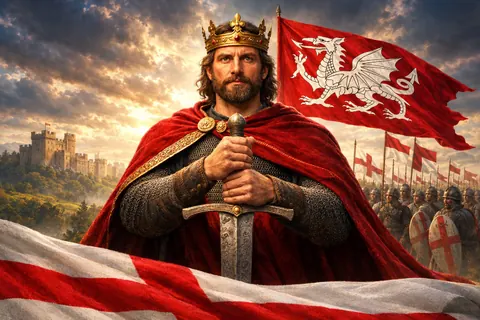

A charity for England’s story
A charity built on a simple idea: heritage belongs to everyone, not to those who keep it. This is where that story starts, eleven centuries in the making.
The Kingdoms Become One
Kingdom boundaries shown are indicative.
After the Romans
The first English people were largely descended from the various Anglo-Saxon invaders who came to Britain after the last Roman legion left. These people came from what is now Northern Germany and Denmark. They were pagan and the names of their gods are preserved in our days of the week, like "Wodin's day" and "Thor's day".
Kent
Was the first Anglo-Saxon kingdom to convert to Christianity, in the 7th century, after Pope Gregory sent missionaries lead by England's first Bishop - Augustine. Kent is where Augustine landed and that is why the head of the English church resides in Canterbury. It took many decades though before all the English kingdoms converted to Christ.
The Viking Invasion
Under the leadership of Offa the English kingdoms became so prosperous that invaders from Norway and Denmark began to set upon isolated communities, stealing their valuable artefacts and raping and murdering the local populace.
Four Kingdoms
In 865 though that changed as the Great Heathen Army landed in Essex. By this date there were only 4 separate English kingdoms in existence, each with their own king and laws. Each kingdom was attacked separately by this Danish / Heathen Army.
Northumbria
The great northern kingdom that ran from the Humber estuary all the way to what is Firth of Forth. For a time, the most learned place in western Europe, a forerunner of English Christianity, and home to St. Cuthbert and the Venerable Bede. It fell first to the Heathen Army at York in 866, weakened by a dispute between 2 kings.
Mercia
In winter 867 Heathen Army descended on Nottingham, but Wessex came to Mercia's aid and the Danes retreated to York, but leaving some of Mercia under their control.
East Anglia
On its return to East Anglia in 869, the Danes routed the East Anglia army under King Edmund who was famously murdered, later to become England's first Patron Saint.
Wessex & 927
Alfred the Great had held Wessex against the Vikings. After Alfred's victory at Edington in 878 the Danes agreed to divide England in half. Wessex allied with Mercia through the marriage of Alfred's daughter to Athelred, but the Danelaw covered the east and north. It was Alfred's grandson, Athelstan who united all the English people in 927.
927 to 2027
How old is England?
England’s age is counted from 12th July 927, when the kings of Britain met Æthelstan at Eamont, near Penrith, and swore peace with the first king of all the English. On 12th July 2027 England turns 1100.
England’s age today
1,099years and 102 days
Until England turns 1100
- days
- 262
- hours
- 20
- minutes
- 43
- seconds
- 45